A Plea From Your Friendly Social Media Manager: Please Stop Using AI on Your Sale Horse Photos
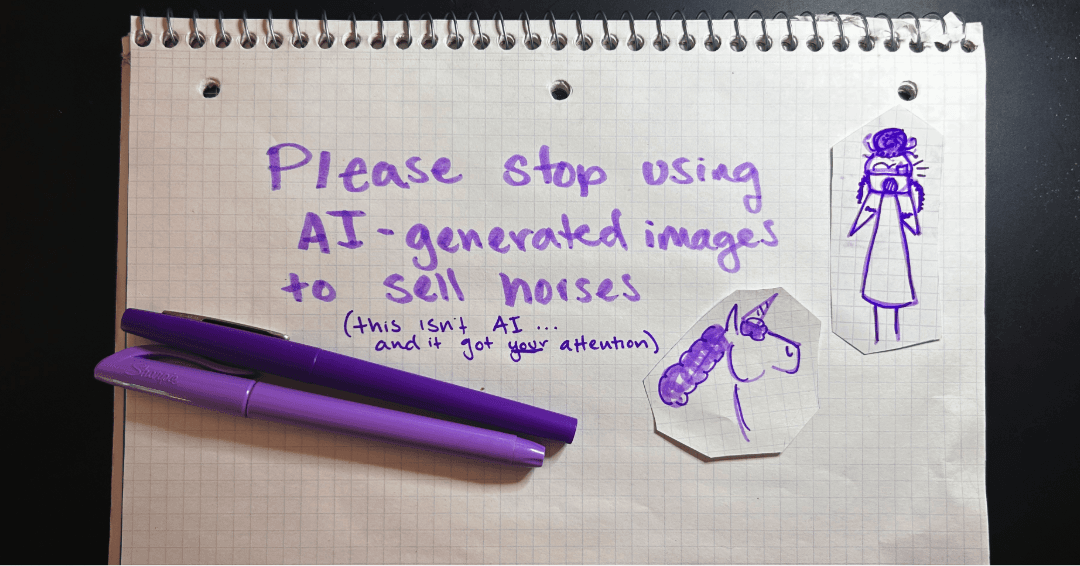
I get it. You want to sell your horse. You have a photo from a show photographer, but it's not quite what you envisioned. The horse looks fine, but not great. The background is the schooling ring. The lighting is flat. And there's this tool that can fix all of it in seconds.
So, you do it. You run the image through AI. And suddenly your sale horse looks like the best version of itself. (Plus, you told it to make the horse look like it’s trotting through the clouds, wow isn’t that cool?)
I understand the temptation. I really do.
Show photos are expensive. Hiring a photographer to come out for a dedicated shoot costs money. Running a photo through AI costs nothing. Your competitors are probably doing it. Why shouldn't you? It's one small edit. It won't hurt.
Except it will.
The horse industry is worth $177 billion annually and supports 1.1 million jobs. (American Horse Council). Horses are among the top 600 most traded products globally, in fact in 2024 the US exported $303 million and imported $720 million worth of horses (The Observatory of Economic Complexity). But unlike when you’re selling your old furniture on Facebook Marketplace, when you're selling a horse, you're not just moving inventory. You're moving money, reputation, and risk.
And right now, you're tempted to use AI because it's faster and cheaper than doing it the right way.
Here's how generating images with an AI Chatbot works: You upload your image and tell the chatbot what you want. "Make the horse more dramatic. Enhance the colors. Remove the watermark. Make it pop."
The computer doesn't edit your photo like Photoshop would. It doesn't cut and paste or layer things. Instead, it scans millions of images — millions of dressage horses, clouds, sunset backgrounds, riding positions, every piece of visual data that matches what you asked for. Then it builds a brand-new image based on all that data.
In other words: it's creating a composite image that's never existed before. It's not enhancing your horse. It's generating a horse that looks like yours but isn't.
And here's the kicker: horses are particularly hard for AI to generate. Reins are confusing. Rider position gets weird. The number of fingers on a hand changes. Brands on helmets disappear. There's always some uncanny valley effect. Every single time I see an AI-generated sale horse photo, I see the mistakes. And so do buyers.
“What else are you hiding?”
That's the question that runs through a buyer's head when they notice something is off about the photo.
Because here's the reality: horse shopping is not for the faint of heart. We all have horror stories. There are stories about dealers transporting horses with false Coggins over state lines. Stories about horses kept on long-lasting sedatives to keep them quiet for a month while they're being shown.
I have heard it all. The seller wasn't straight with us. We trusted the photos, the description, the reputation. The horse was different in person — temperament, soundness, everything. We spent thousands on vet bills trying to figure out what we'd missed.
Horse shopping requires trust. Buyers are making bets with their money, their time, and their safety. When you use AI to alter your sale horse photos, you're not just cutting corners. You're putting yourself in the same category as the people with botched Coggins and painted-on markings. Whether you mean to or not, you've just introduced doubt. You think better photos will sell more horses. You're right. Better photos do sell horses.
But AI-generated photos? Those sell fewer horses.
The professionals who consistently move horses and build buyer loyalty aren't the ones with the most dramatically altered photos. They're the ones buyers trust to be honest with them. Your sale horse deserves honest representation.
Invest in real photos. Commission a photographer, adjust your iPhone settings to capture high-quality, buy photos from the show photographer. Show the horse as it actually is. The best sale horse marketing isn't the most dramatic photo. It's the one that makes a buyer think: "This is real, I trust this seller, I want to see this horse in person, I’d love to see that face in the barn every day."
Use Lightroom, Canva, basic Instagram filters if you want. These tools are designed to enhance without creating false impressions. Your reputation is worth more than a quick edit. The buyers who actually show up and buy horses are the ones who trust you.
So please. I beg you. No more AI-generated sale horse photos.
References
American Horse Council. “Results from the 2023 National Equine Economic Impact Study Released.” The American Horse Council, 31 Jan. 2024, https://horsecouncil.org/press.... Accessed 6 Oct. 2026.
The Observatory of Economic Complexity. “Horses | OEC.” OEC - The Observatory of Economic Complexity, oec.world/en/profile/hs/horses. Accessed 6 Oct. 2026.
About Izzy Bisese
Izzy Bisese is the Chief Marketing Officer and Creative Director at Mythic Landing Enterprises, a boutique equestrian marketing and business management firm that helps equestrians build sustainable, profitable businesses. Founded in 2008, MLE is a multi-member team based in Maryland, MLE serves clients across the country and internationally. To learn more, visit mythiclanding.com.
Related Articles
Fast Facts: 2026 USEA Young Event Horse East Coast Championships
Sixty of the country's top young horses are headed to Elkton, Maryland, for the 2026 USEA Young Event Horse (YEH) East Coast Championships, held alongside the CCI3*-L at Fair Hill. The field in...
Derek di Grazia to be Inducted into U.S. Eventing Hall of Fame in December at the USEA Annual Meeting & Convention
Since 1999, more than 50 outstanding horses and people have been inducted into the U.S. Eventing Hall of Fame. Induction into the Hall of Fame is the highest honor awarded within the sport of eventing in the United States that is only bestowed to individuals who have made significant contribution...
Never Say Never: Devoted Area VII Volunteer Sarah Airhart Completes Her First USEA Recognized Event
Sarah Airhart had it made. She was enjoying a half lease on a 16.2 Warmblood named Pantero (Rex Grannus x Tibet) that she adored and whose owner, Ronni McLaughlin-Remy, was willing to take them wherever they’d liked. She also landed a coach who she long admired through her 12 years of volunteerin...