The Work of Breathing: Respiratory Load and the Young Event Horse

Developing a young event horse is an exercise in patience and detail. Riders build fitness gradually, introduce new questions carefully, and pay close attention to soundness, nutrition, and confidence. One part of the workload is easy to overlook because it rarely shows itself: the work of breathing. As this year's USEA Young Event Horse Championships approach, it is worth understanding what that work involves, why it matters for young horses, and which part of it riders can influence.
What Respiratory Load Is
Respiratory load describes the demands placed on breathing, and the effort required to meet them during exercise. Three factors shape it. Airflow is how much air has to move, and how fast. Airway resistance is what that air meets on the way through. Mechanical effort is the work of moving the lungs and chest wall.
As exercise intensifies, a horse must move more air. The breathing muscles generate the pressure that draws that air in, and any resistance along the airway adds to the effort. The harder the breathing, the greater the load.
This matters because the lungs are a primary limiting factor in equine performance. Unlike the heart and muscles, the lungs do not adapt to training. A conditioning program builds muscle, bone, and cardiovascular fitness, but it does not build a bigger airway.
Why Young Horses Feel the Load
Respiratory load is not fixed. It shifts with intensity, duration, and repetition. A short, fast effort concentrates the demand. A sustained gallop extends it. Repeated efforts stack it, and recovery between them becomes part of the picture.
Young horses meet these demands while still learning the job. They have not yet developed the balance, rhythm, and technique that let an experienced horse cover ground economically. A green horse may jump bigger than necessary, rush in places, or carry tension in a new environment, and each of these adds to the effort of breathing.
Jumping adds its own challenge. Horses hold their breath over a fence and resume breathing on landing, and rounding the body over an obstacle increases airway resistance. Across a course, those moments add up. A championship setting layers on unfamiliar surroundings, a longer day, and a warm-up to manage before the horse is asked to perform.
It Starts at the Nose
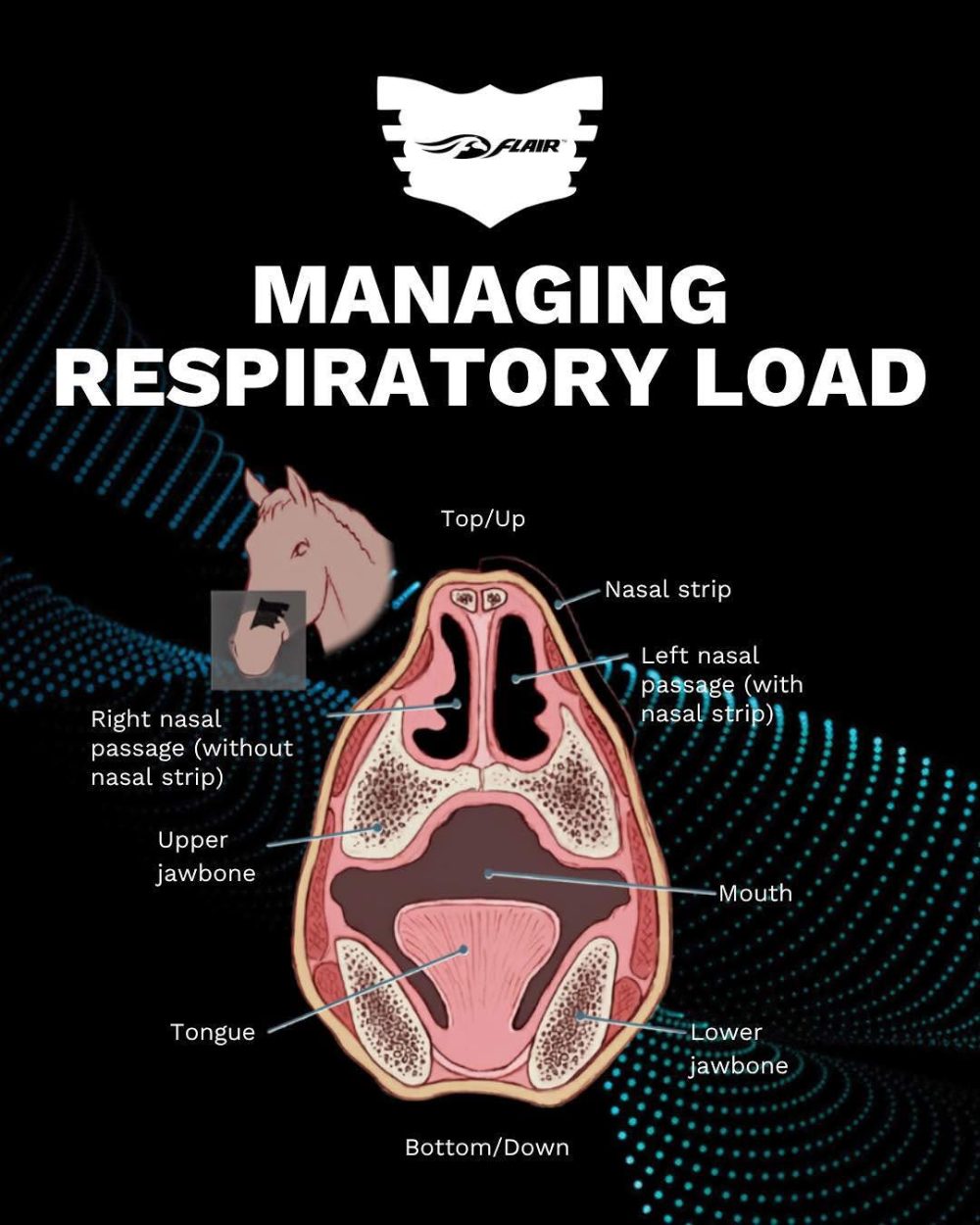
Horses are obligate nasal breathers, meaning every breath must pass through the nasal passages. These passages are the narrowest part of the upper airway and a major source of resistance during strenuous exercise. When a horse inhales, the negative pressure that draws air in also pulls the soft tissues over the nasal passages inward. As the passage narrows, resistance rises, and the horse must work harder to keep air moving.
FLAIR® Equine Nasal Strips support those tissues to reduce inward collapse during inhalation. Independent research on FLAIR Strips has shown significantly reduced inspiratory airway resistance in exercising horses, lower oxygen consumption, and reduced severity of exercise-induced pulmonary hemorrhage (EIPH).
That last finding is especially relevant for a young horse. EIPH is usually invisible, and damage from repeated bleeding accumulates over a career. A horse at the start of its career has the most to protect.
Building Breathing Into the Plan
Most of a young horse's education happens at home. Conditioning gallops, cross-country schooling, and gridwork sessions are all real respiratory work. Consider where the hardest efforts fall, how long they last, how often they repeat, and how much recovery the horse gets in between. Nasal support belongs in those sessions, not only on show day.
Sound conditioning, airway health, good air quality in the barn and trailer, and appropriate recovery remain the foundation of respiratory management. Nasal support has a defined role within that plan. FLAIR Strips are drug-free, non-invasive, veterinarian-developed, and competition-legal across most disciplines.*
The young horses competing at this year's Championships represent the future of the sport, and we at Achieve Equine are proud to support them. Every stride provides a breath, and every breath requires work. Recognizing that work early is one more way to give a young horse the strongest possible start.
Performance Starts at the Nose.®
*Note FLAIR Strips are not currently in FEI Dressage competition.
Related Articles
Never Say Never: Devoted Area VII Volunteer Sarah Airhart Completes Her First USEA Recognized Event
Sarah Airhart had it made. She was enjoying a half lease on a 16.2 Warmblood named Pantero (Rex Grannus x Tibet) that she adored and whose owner, Ronni McLaughlin-Remy, was willing to take them wherever they’d liked. She also landed a coach who she long admired through her 12 years of volunteerin...

Centerline Success : An Afternoon of Learning, Insight, & Inspiration at Devon
Center Line Success, sponsored by Team Tate Academy and hosted by USDF, provided its 80 attendees with a wealth of knowledge to put into practice. Jeanne McDonald, USEF “S” Dressage judge, and Heather Gillette, USEF “S” Eventing judge, generously took time out of their day to present and all atte...

Pressure Proof Tip with Daniel Stewart: Fears and Our Inner Flinstones
Last month we began discussing the fact that many of the fears we experience today can be attributed back to the survival instinct born in all of us thousands of years ago. We even talked about how the fear of being watched (the spectator effect) can be attributed back to the fear our caveman and...